

Kumbh Mela vs Ardh Kumbh vs Maha Kumbh: What’s the Difference?
Kumbh Mela, Ardh Kumbh and Maha Kumbh are related Hindu pilgrimage gatherings, but their names, traditional timing and usage differ. Kumbh Mela is associated with four sacred locations and a roughly 12-year interval at each site. Ardh Kumbh means “half Kumbh” and traditionally takes place at approximately six-year intervals in Prayagraj and Haridwar. Maha Kumbh is a designation for a particularly significant gathering, especially in Prayagraj. Its commonly cited 144-year cycle requires historical and religious context. The 2025 Prayagraj event was officially designated Maha Kumbh Mela.
Kumbh Mela vs Ardh Kumbh vs Maha Kumbh: Quick Comparison
The following table summarizes the usual distinctions while accounting for differences in religious interpretation and official terminology.
| Feature | Kumbh Mela | Ardh Kumbh Mela | Maha Kumbh Mela |
|---|---|---|---|
| Basic meaning | A major Hindu pilgrimage gathering | Literally, half Kumbh | A designation for a particularly significant Kumbh gathering |
| Commonly described interval | Roughly 12 years at a particular site | Approximately six years at Prayagraj and Haridwar | Some traditions and official explanations associate it with 144 years at Prayagraj |
| Main locations or context | Prayagraj, Haridwar, Ujjain and Nashik–Trimbakeshwar | Traditionally associated with Prayagraj and Haridwar | Closely associated with Prayagraj in contemporary official usage |
| Religious significance | Sacred bathing, worship, pilgrimage and spiritual gatherings | Similar devotional practices within the wider Kumbh tradition | Special significance attributed according to the relevant tradition |
| Astrological considerations | Site-specific combinations involving celestial positions and the Hindu calendar | Timing follows relevant local traditions | Particular astrological interpretations may be used to explain its special designation |
| Important rituals | Snan, prayers, discourses and ascetic processions | Snan, prayer and religious gatherings | Major bathing occasions, akhara processions, prayers and religious discourses |
| Historical context | A tradition whose recorded forms developed over time | A term associated with intermediate gatherings at two sites | A designation whose meaning and application vary across sources |
| Key distinction | The broad pilgrimage tradition | An intermediate gathering in certain cycles | A designation whose exact relationship with the regular Kumbh cycle needs context |
Government tourism sources describe Kumbh Mela at the four traditional sites and the six-year Ardh Kumbh tradition at Prayagraj and Haridwar. The 2025 Prayagraj event, meanwhile, was officially called Maha Kumbh Mela. Historical research shows why it is important not to assume that every source uses these categories in exactly the same way.
What Is Kumbh Mela?
Kumbh Mela is a major Hindu pilgrimage gathering centred on sacred bathing, worship, religious teaching and meetings among spiritual communities. It draws pilgrims, ascetics, saints, sadhus, sadhvis and visitors to designated pilgrimage locations in India.
The Sanskrit word kumbha means a pot or pitcher. Mela refers to a gathering or fair. Together, the name evokes the festival of the sacred pitcher.
The Religious Story Behind Kumbh Mela
According to Hindu tradition, Kumbh Mela connects with the story of Samudra Manthan, or the churning of the cosmic ocean. In the traditional account, the gods and demons sought amrita, the nectar of immortality. During the struggle surrounding the nectar, drops are said to have fallen at four earthly locations: Prayagraj, Haridwar, Ujjain and Nashik.
This story explains the religious association among the four pilgrimage sites. It belongs to Hindu religious tradition and should be presented as such, rather than as an independently verified historical event.
Why Is Ritual Bathing Important?
Many Hindu devotees believe that bathing in sacred rivers on auspicious occasions can purify the soul, support spiritual renewal and help them move towards moksha, or liberation from the cycle of rebirth.
The meaning of the ritual depends on the beliefs and practices of the individual and their religious tradition. Bathing is central to Kumbh Mela, but the festival also includes prayer, spiritual discourse, devotional service, meditation and interactions with religious teachers.
UNESCO added Kumbh Mela to its Representative List of the Intangible Cultural Heritage of Humanity in 2017. Its description recognizes the knowledge, practices and community traditions associated with the gathering.
Why Are There Four Kumbh Mela Locations?
Each location has its own sacred geography and religious traditions. The gathering’s timing is linked to astrological calculations involving celestial positions and the Hindu calendar.
The locations do not simply take turns according to one inflexible schedule. Their religious authorities and organizing administrations account for the relevant timing traditions when determining each event. This is why readers should check the official announcement for a particular location instead of relying only on a general 12-year rule.
What Is Ardh Kumbh Mela?
Ardh is commonly translated as “half.” Ardh Kumbh Mela is traditionally associated with an intermediate gathering in the wider Kumbh cycle.
The six-year interval is particularly associated with Prayagraj and Haridwar. It does not mean that all four Kumbh locations hold an Ardh Kumbh on the same schedule.
How Often Does Ardh Kumbh Take Place?
Official Uttarakhand tourism information describes Ardh Kumbh at Haridwar every six years. Government tourism material also identifies Prayagraj as a traditional Ardh Kumbh location. These intervals help explain the familiar distinction between a full Kumbh gathering and an intermediate event.
However, official event terminology has changed in practice. In a 2019 statement, the Press Information Bureau reported that the Uttar Pradesh government had decided to call that year’s Prayagraj Ardh Kumbh a Kumbh and to call a Kumbh a Maha Kumbh. This is one reason the names cannot be understood through intervals alone.
What Happens During Ardh Kumbh?
Pilgrims participate in sacred bathing, prayers, devotional activities and religious gatherings. Ascetics and religious orders also take part in the wider festival.
The central practices resemble those of other Kumbh gatherings. The term Ardh primarily describes its position in a traditional cycle, not a separate religion or a lesser form of Hindu worship.
There is also no basis for assuming that an Ardh Kumbh automatically attracts half the people, offers half the facilities or holds half the spiritual value of another gathering.
What Is Maha Kumbh Mela?
Maha Kumbh means “great Kumbh.” In contemporary official usage, the term is closely associated with a major gathering at Prayagraj, where the Ganga and Yamuna meet at the Triveni Sangam, traditionally understood to include the invisible or mythical Saraswati.
Devotees regard the Sangam as a particularly sacred place for ritual bathing. The gathering brings together pilgrims, ascetics, spiritual organizations and religious teachers for bathing occasions and other religious activities.
How Does Maha Kumbh Relate to the 12-Year Cycle?
The relationship between the regular Kumbh cycle and the term Maha Kumbh needs careful explanation.
Some religious interpretations and official descriptions associate Maha Kumbh at Prayagraj with a 144-year interval. This explanation is often connected with 12 successive 12-year cycles. The Government of India’s account of the 2025 gathering used this 144-year description.
However, the term has not been used consistently across all modern government records. A Prayagraj district page describing the 2013 event called it the most recent Maha Kumbh and identified 2025 as the next one. The 2019 government announcement also described a change in the labels used for that year’s Ardh Kumbh and Kumbh.
Historical scholarship adds another layer. In Pilgrimage and Power: The Kumbh Mela in Allahabad, 1765–1954, historian Kama Maclean examines the historical development of the Prayagraj gathering and the growth of the Kumbh designation in modern records. Her work cautions against assuming that present-day labels and schedules have always existed in their current form.
These differences do not diminish the religious meaning that devotees attach to Maha Kumbh. They show why a useful explanation should distinguish a particular religious interpretation, the historical record and the name chosen by event organizers.
What Is the Main Difference Between Kumbh, Ardh Kumbh and Maha Kumbh?
The clearest way to understand the difference is to separate the broad pilgrimage tradition, the intermediate gathering and the special event designation.
Kumbh Mela is the broad tradition associated with four sacred sites. Ardh Kumbh refers to an intermediate gathering traditionally held approximately every six years at Prayagraj and Haridwar. Maha Kumbh is a designation associated especially with Prayagraj, but its precise relationship with the regular 12-year Kumbh cycle depends on the source and interpretation.
For example, a reader researching a Prayagraj event might find a source describing its place in the 12-year cycle, another calling it Maha Kumbh and a historical study examining how the names developed. These sources may be addressing different questions. The correct approach is to check the date, location, official event name and explanation of the religious tradition before drawing conclusions.
How Often Is Each Kumbh Mela Held?
The intervals most commonly used to explain the three terms are:
- Kumbh Mela: Roughly 12 years between principal Kumbh gatherings at a given site.
- Ardh Kumbh Mela: Approximately six years at Prayagraj and Haridwar.
- Maha Kumbh Mela: Often associated with a 144-year cycle in particular explanations, although official naming and historical interpretations require context.
These are useful general descriptions, not a universal calendar that applies identically to all four locations.
Traditional timing takes account of astrological positions and the Hindu calendar. The relevant combinations differ by site. For that reason, the precise bathing occasions for any future event should come from the relevant official administration, rather than an estimate based on the previous gathering alone.
Where Are the Four Traditional Kumbh Melas Held?
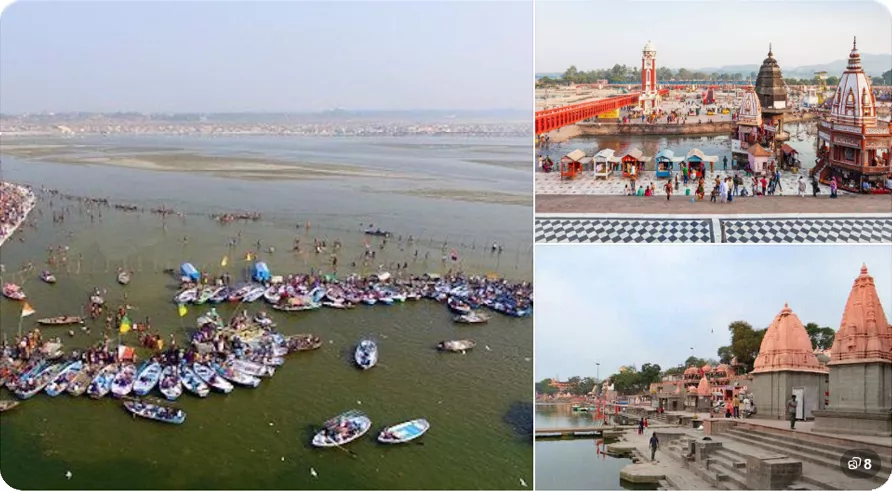
1. Prayagraj, Uttar Pradesh
Prayagraj is the site of the Triveni Sangam, where the Ganga and Yamuna meet and where Hindu tradition places the invisible or mythical Saraswati. Devotees consider bathing at this confluence particularly auspicious.
The city’s strong association with Maha Kumbh reflects its religious significance, the scale of its pilgrimage tradition and its central role in the modern official naming of the event. Prayagraj also hosts the annual Magh Mela, which helps explain the site’s broader pilgrimage calendar.
2. Haridwar, Uttarakhand
Haridwar stands on the Ganga near the point where the river enters the plains. Har Ki Pauri is among its best-known sacred bathing areas.
Kumbh Mela at Haridwar follows its own astrological timing, and the city is also associated with the six-year Ardh Kumbh tradition. Its religious significance comes from its connection with the Ganga, its pilgrimage sites and its long-established bathing practices.
3. Ujjain, Madhya Pradesh
Ujjain hosts the Simhastha Kumbh on the banks of the Shipra River. The name Simhastha is associated with the astrological conditions used to determine the gathering’s timing.
The gathering combines sacred bathing with worship and the participation of religious communities. Its traditions are distinct from those of Prayagraj and Haridwar, even though all three belong to the wider Kumbh pilgrimage tradition.
4. Nashik–Trimbakeshwar, Maharashtra
Nashik and nearby Trimbakeshwar are associated with Kumbh Mela on the Godavari River. The pilgrimage connects sacred bathing with local temple traditions and astrological calculations.
The timing is not interchangeable with that of Prayagraj or Haridwar. Maharashtra’s official district information explains the relevant religious and astrological background for the Nashik–Trimbakeshwar gathering.
Why Is Prayagraj Especially Important for Maha Kumbh?
Prayagraj’s importance begins with the Triveni Sangam. Hindu tradition regards the confluence of the Ganga, Yamuna and Saraswati as an especially auspicious place for pilgrimage and ritual bathing.
The site also brings together a broad range of religious activities. Pilgrims bathe, offer prayers, listen to religious teachers and visit camps associated with spiritual communities. Akharas and ascetic orders play a prominent part in major bathing occasions.
Prayagraj’s established role in the annual Magh Mela and larger Kumbh gatherings also provides historical and administrative context for its modern association with the Maha Kumbh designation. The official name, however, should not be taken as proof that every religious authority interprets the term or its cycle identically.
What Was the Difference Between Kumbh Mela and Maha Kumbh Mela in 2025?
The 2025 Prayagraj event ran from 13 January to 26 February 2025. The Prayagraj district administration officially listed it as Maha Kumbh Mela 2025, and the Ministry of Tourism also promoted it under that name.
Its religious programme included major bathing occasions such as Paush Purnima, Makar Sankranti, Mauni Amavasya, Basant Panchami, Maghi Purnima and Maha Shivratri. The gathering also featured religious processions, activities organized by akharas, devotional programmes and services for visitors.
The event was notable both for its religious significance and for the scale of its organization. The government described it as a Maha Kumbh associated with a rare 144-year cycle. At the same time, earlier government material had used Maha Kumbh and Kumbh labels differently. This makes the 2025 designation an important example of how contemporary official usage can coexist with a more complex historical record.
Because the event ended on 26 February 2025, it should now be discussed in the past tense. Readers planning a future pilgrimage should consult current official notices rather than reuse the 2025 schedule.
What Happens During Kumbh Mela?
Kumbh Mela is more than a series of ritual bathing occasions. Its activities bring together worship, spiritual learning and community life.
- Ritual bathing: Devotees visit the designated bathing areas on important dates or at other times during the gathering.
- Akharas and ascetic traditions: Religious orders and ascetics take part in processions, bathing rituals and community activities.
- Religious discourses: Teachers and spiritual leaders give talks on religious texts, philosophy and devotional practice.
- Prayer and worship: Pilgrims perform personal prayers, ceremonies and other devotional activities.
- Pilgrimage and darshan: Visitors may seek blessings at religious camps, temples and designated worship areas where available.
- Community gatherings: Pilgrims meet spiritual teachers, learn about religious traditions and participate in devotional programmes.
The exact activities and facilities vary by location and event. Kumbh Mela also includes practical arrangements for transport, accommodation, medical assistance, sanitation and crowd management. Visitors should use official information when planning their participation.
What Is the Significance of Shahi Snan or Amrit Snan?
Snan means bathing. Shahi Snan, often translated as “royal bath,” refers to important ritual bathing occasions in which akharas and ascetic orders take part in an organized sequence.
During the 2025 Prayagraj gathering, Amrit Snan became a widely used term for these prominent bathing occasions, replacing the earlier common term Shahi Snan in much official and media communication. The terminology reflected a change in event usage, while the ritual itself remained rooted in established bathing and procession traditions.
These occasions receive special attention because of their religious associations and the organized participation of ascetic orders. The dates are connected with the relevant festival calendar and astrological traditions.
The terms should be explained in context. Shahi Snan is the older, widely recognized expression, while Amrit Snan became prominent in the 2025 event. Sources from earlier gatherings may continue to use Shahi Snan.
Is Maha Kumbh More Important Than Kumbh Mela?
There is no single answer that applies to every Hindu tradition or pilgrim.
Some devotees and religious authorities attach special significance to Maha Kumbh because of the particular astrological and religious interpretation associated with it. Other pilgrims focus on the sanctity of the site, the auspicious bathing occasion, their personal devotional goals or their relationship with a religious teacher.
The official designation, crowd size and amount of event infrastructure do not independently establish spiritual superiority. A pilgrimage’s importance depends on the traditions and beliefs through which a person understands it.
Readers should therefore distinguish the special status attributed to an event within a particular tradition from a universal claim that every pilgrim must regard it as spiritually greater.
Is Ardh Kumbh Smaller Than Kumbh Mela?
The word Ardh means half, and it describes the gathering’s place in a traditional cycle. It does not prove that the event has half the attendance, half the infrastructure or half the spiritual importance of a Kumbh Mela.
Attendance and facilities depend on the specific event, its location, transport arrangements, available accommodation and other practical factors. An event’s scale can vary from one occasion to another.
The more reliable distinction is the traditional interval and the locations associated with Ardh Kumbh, rather than an assumption that the word automatically defines its size or religious value.
Kumbh Mela vs Ardh Kumbh vs Maha Kumbh: Which Should You Visit?
The right gathering depends on your religious interests and travel needs, not on a universal ranking of spiritual importance.
Consider these questions before choosing an event:
- Religious interests: Are you most interested in the Triveni Sangam, the Ganga at Haridwar, the Shipra at Ujjain or the Godavari at Nashik–Trimbakeshwar?
- Travel dates: Have the official bathing dates been announced?
- Time and budget: How much time can you set aside for travel, accommodation and participation?
- Crowd tolerance: Would you be comfortable attending a major bathing occasion, or would you prefer a less crowded time?
- Accessibility: Will elderly family members, children or travellers with disabilities need specific facilities?
- Accommodation: Can you secure suitable lodging and transport before travelling?
First-time visitors may find it helpful to choose a location based on their devotional interests and practical circumstances. Large bathing occasions can involve significant crowds, so the ability to follow local instructions and travel safely should be part of the decision.
Practical Tips for First-Time Kumbh Mela Visitors
Plan around the official event schedule rather than an estimated date based on a previous Kumbh cycle.
- Check official dates and notices. Use the relevant district administration, mela authority or state tourism website for bathing dates and travel advisories.
- Arrange travel and accommodation early. Demand can rise considerably around major bathing occasions.
- Follow crowd-management instructions. Use designated routes and bathing areas, and follow instructions from event staff and local authorities.
- Protect essential documents. Keep identification, booking details and emergency contacts secure.
- Prepare for the weather. Carry suitable clothing, drinking water where permitted and other essentials for the season.
- Know where to get help. Identify official help desks, medical facilities and emergency assistance points.
- Follow bathing-area safety rules. Respect barriers, river conditions and instructions from staff. Do not enter restricted or unsafe areas.
- Make a group meeting plan. Establish a meeting point in case family members or companions become separated.
- Respect religious customs. Follow local guidance around processions, places of worship, religious camps and bathing rituals.
- Check accessibility arrangements. If travelling with someone who has limited mobility, confirm available transport and accommodation before departure.
These general precautions apply across major pilgrimage gatherings. Specific arrangements can change with each event, so check the latest instructions before setting out.
Frequently Asked Questions
What Is the Difference Between Kumbh Mela and Ardh Kumbh?
Kumbh Mela is the broader pilgrimage tradition associated with four sacred locations. Ardh Kumbh is traditionally held at approximately six-year intervals at Prayagraj and Haridwar. Both include ritual bathing, prayer, religious gatherings and participation by ascetics.
What Is the Difference Between Kumbh Mela and Maha Kumbh?
Kumbh Mela is the broader festival tradition, while Maha Kumbh is a designation for a particularly significant gathering, especially at Prayagraj. Some official explanations associate it with a 144-year cycle, but usage varies across historical and administrative sources.
Is Maha Kumbh Held Every 144 Years?
Some religious interpretations and government descriptions associate Maha Kumbh at Prayagraj with a 144-year cycle. However, official records have used the term differently for earlier events. The 144-year interval should therefore be attributed to the relevant tradition or source rather than presented as a universally agreed historical rule.
How Often Is Ardh Kumbh Held?
Ardh Kumbh is traditionally associated with an approximately six-year interval at Prayagraj and Haridwar. Exact event timing follows the relevant religious and astrological calendar. The interval does not apply identically to every one of the four Kumbh locations.
Where Are the Four Traditional Kumbh Melas Held?
The four traditional locations are Prayagraj in Uttar Pradesh, Haridwar in Uttarakhand, Ujjain in Madhya Pradesh, and Nashik–Trimbakeshwar in Maharashtra. Their sacred waterways are the Triveni Sangam, the Ganga, the Shipra and the Godavari, respectively.
Why Is Prayagraj Important for Maha Kumbh?
Prayagraj is home to the Triveni Sangam, traditionally understood as the meeting point of the Ganga, Yamuna and Saraswati. Hindu devotees regard bathing at this confluence as especially auspicious. The city also has an established history of major pilgrimage gatherings.
Are Kumbh Mela and Maha Kumbh the Same?
They are related, but the terms are not always used identically. Kumbh Mela is the broader pilgrimage tradition; Maha Kumbh is a particular designation used in some religious explanations and official event names. Historical and administrative sources have applied the labels differently.
Why Is Kumbh Mela Held at Different Locations?
According to Hindu tradition, drops of amrita fell at four sacred places during the story of Samudra Manthan. The four sites are Prayagraj, Haridwar, Ujjain and Nashik–Trimbakeshwar. Religious traditions and site-specific astrological calculations determine the timing of their gatherings.
What Is the Religious Significance of Taking a Holy Dip?
Many Hindu devotees believe bathing in sacred rivers on auspicious dates supports spiritual purification and devotion. Some associate the ritual with liberation from the cycle of rebirth. The meaning of the bath depends on individual beliefs and religious traditions.
What Is the Difference Between Shahi Snan and Amrit Snan?
Shahi Snan means “royal bath” and was widely used for important ritual bathing occasions involving akharas and ascetic orders. Amrit Snan became a prominent alternative term during the 2025 Prayagraj gathering. Both refer to significant bathing rituals, but their usage depends on the event and period.
How Are Kumbh Mela Dates Determined?
Traditional calculations consider celestial positions, including those of Jupiter, the Sun and the Moon, alongside the Hindu calendar. The combinations differ among locations. For confirmed dates, consult the official administration responsible for the specific gathering.
Was the 2025 Prayagraj Event Called Maha Kumbh?
Yes. The Prayagraj district administration and the Ministry of Tourism officially used the designation Maha Kumbh Mela 2025. It ran from 13 January to 26 February 2025.
Does Every Kumbh Location Hold Ardh Kumbh?
No. The traditional six-year Ardh Kumbh interval is associated with Prayagraj and Haridwar. Ujjain and Nashik–Trimbakeshwar have their own regional Kumbh traditions and timing calculations.
Which Kumbh Mela Should First-Time Visitors Attend?
Choose according to your religious interests, preferred location, travel dates, budget, accessibility needs and comfort with crowds. Check the official bathing schedule and available accommodation before deciding. No single gathering is automatically the best choice for every visitor.
Where Can Visitors Find Official Kumbh Mela Updates?
Start with the relevant district administration, mela authority and state tourism website. The Prayagraj district administration publishes event information for Prayagraj, while Uttarakhand tourism provides information about Haridwar. Always check current notices before booking or travelling.
Important link: