
13 Akharas in India: Names, History and Significance
The 13 akharas in India are commonly recognized religious organizations associated with ascetic traditions and the Kumbh Mela. An akhara brings together sadhus, sannyasis or other religious practitioners within an established tradition. These organizations preserve religious teachings, maintain spiritual lineages and participate in major religious gatherings.
The commonly recognized list contains seven Shaiva or Sanyasi akharas, three Vaishnava or Vairagi akharas, two Udasin akharas and one Nirmal Akhara. This grouping reflects a widely used classification, although sources sometimes place the Nirmal tradition within a broader Udasin grouping.
Their histories are complex. Traditional accounts connect the akhara system with Adi Shankaracharya, while historical research documents the development of organized ascetic groups and armed Naga sannyasis in particular periods. These accounts should not be treated as proof that one historical figure personally founded all 13 organizations.
This guide explains the names of the 13 akharas, their broad religious affiliations, their historical development, their significance in Hindu religious life and their role in the Kumbh Mela.
What Is an Akhara?
An akhara is an organized religious institution or order associated with a particular ascetic lineage, set of teachings or religious community. In the context of the Kumbh Mela, the word generally refers to an established organization of religious practitioners.
The word also has wider cultural meanings. In other contexts, it can refer to a wrestling ground or a place for physical training. Its meaning therefore depends on the historical and social setting.
Religious akharas may serve several purposes:
- Spiritual instruction: Experienced teachers pass on religious teachings and practices.
- Initiation: Eligible practitioners may join a lineage through religious initiation, according to its customs.
- Ascetic discipline: Members may follow particular rules concerning renunciation, worship and daily life.
- Institutional continuity: Religious leaders maintain traditions, ceremonies and organizational identities.
- Community and pilgrimage: Akharas bring practitioners together during religious gatherings and important ceremonies.
Their structures and practices vary. It would be inaccurate to assume that every akhara follows the same rules, teaches identical philosophies or trains all members in martial arts.
What Do Sadhus and Sannyasis Mean?
A sadhu is a person who follows a religious or spiritual life, often marked by renunciation or disciplined practice. A sannyasi is a renunciant, particularly in Hindu traditions where sannyasa represents a formal stage or commitment to renunciation.
These terms overlap in everyday usage, but they do not describe exactly the same identity in every tradition. Akharas are institutions, while sadhus and sannyasis are people who may belong to them.
How Many Akharas Are There in India?
The commonly recognized number is 13 major akharas associated with the Kumbh Mela system. The Akhil Bharatiya Akhara Parishad identifies 13 main akharas, and the 2025 Maha Kumbh arrangements included these organizations.
This number requires some context.
- It refers to the established group of major akharas commonly discussed in connection with the Kumbh Mela.
- It does not mean that India has only 13 religious orders, monastic institutions or organizations that use the word akhara.
- Other ascetic groups, religious communities and institutions may have separate identities.
- Recognition, participation and the use of the term can vary across organizations and gatherings.
For this reason, the list below follows the commonly recognized 13-akharas convention rather than attempting to catalogue every ascetic institution in India.
List of 13 Akharas in India
The following table uses commonly accepted names, with formal titles included where they are useful. Spellings vary across English-language sources because the names originate in Indian languages and religious traditions.
| No. | Name of Akhara | Broad Tradition | Key Characteristics and Notes |
|---|---|---|---|
| 1 | Shri Panch Dashnam Juna Akhara | Shaiva/Dashanami | A major Naga sannyasi organization associated with Shaiva ascetic traditions. |
| 2 | Shri Panchayati Akhara Niranjani | Shaiva/Dashanami | Part of the established Sanyasi akhara group. |
| 3 | Shri Panch Atal Akhara | Shaiva/Dashanami | One of the seven commonly listed Shaiva akharas. |
| 4 | Shri Panchayati Akhara Mahanirvani | Shaiva/Dashanami | An established Shaiva ascetic organization. |
| 5 | Shri Panchayati Akhara Anand | Shaiva/Dashanami | Also known through the expanded name Taponidhi Shri Anand Akhara Panchayati. |
| 6 | Shri Panch Dashnam Avahan Akhara | Shaiva/Dashanami | Associated with the Dashanami ascetic tradition. |
| 7 | Shri Panch Dashnam Agni Akhara | Shaiva/Dashanami | A distinct organization within the broader Dashanami-associated group. |
| 8 | Shri Nirvani Ani Akhara | Vaishnava/Vairagi | One of the three commonly recognized Vaishnava Ani akharas. |
| 9 | Shri Digambar Ani Akhara | Vaishnava/Vairagi | Associated with the Vaishnava Vairagi tradition. |
| 10 | Shri Nirmohi Ani Akhara | Vaishnava/Vairagi | Another member of the three-akharas Vaishnava group. |
| 11 | Shri Panchayati Akhara Bada Udasin | Udasin | Associated with the Bada Udasin tradition. |
| 12 | Shri Panchayati Akhara Naya Udasin | Udasin | Associated with the Naya Udasin tradition. |
| 13 | Shri Panchayati Nirmal Akhara | Nirmal tradition | Connected with the Nirmal religious tradition and its distinctive Sikh historical context. |
Classification note: Many reports describe the 13 akharas as seven Shaiva, three Vaishnava and three Udasin. Other sources distinguish the Nirmal Akhara from the two Udasin akharas. This article names the Nirmal Akhara separately to acknowledge its distinct history. The classification is a useful overview, not a complete description of every organization’s beliefs or identity.
The 13 Akharas in India Explained Individually
The following profiles explain the main identity of each organization without assigning unsupported founding dates, membership figures or unique practices.
1. Juna Akhara
Commonly associated name: Shri Panch Dashnam Juna Akhara
Juna Akhara is one of the best-known organizations within the Shaiva ascetic tradition. It is associated with Dashanami sannyasis and Naga ascetics, who are prominent participants in major Kumbh gatherings. Its public visibility reflects the important place of Naga sannyasis in religious processions and ceremonial bathing.
The term Naga sadhu describes an ascetic identity, not the name of an organization. Juna Akhara is an institution with its own lineage and organizational structure. Its history should be understood within the wider development of Dashanami monastic orders and organized ascetic communities.
2. Niranjani Akhara
Niranjani Akhara belongs to the Shaiva or Sanyasi group of the recognized akharas. It participates in the institutional and ceremonial life associated with the Kumbh Mela.
The name is commonly shortened to Niranjani Akhara in news coverage. Its identity is best understood through its membership in the established Shaiva ascetic order rather than through unverified claims about a particular founding year or a single defining practice.
3. Atal Akhara
Atal Akhara, also known as Shri Panch Atal Akhara, is one of the seven akharas commonly grouped within the Shaiva Sanyasi tradition.
It appears in official and media accounts of the Kumbh Mela’s ceremonial organization. Such participation demonstrates the role of akharas as recognized religious bodies that maintain their identities while taking part in shared gatherings. Claims about its origins or internal rules should be checked against institutional or historical evidence rather than inferred from its name.
4. Mahanirvani Akhara
Mahanirvani Akhara is another established member of the Shaiva ascetic group. Its expanded name is commonly given as Shri Panchayati Akhara Mahanirvani.
It participates in major Kumbh ceremonies and has a recognized place in the ceremonial arrangements of the akharas. Historical research on Dashanami Naga sannyasis includes discussion of Mahanirvani, offering a stronger basis for studying its institutional history than popular origin stories alone.
5. Anand Akhara
Anand Akhara is commonly referred to by the expanded name Taponidhi Shri Anand Akhara Panchayati. It belongs to the Shaiva or Sanyasi grouping.
Its participation in Kumbh gatherings places it within the network of ascetic organizations that maintain religious traditions and public ceremonial roles. Readers should not assume that its institutional customs are identical to those of Juna, Niranjani or Mahanirvani simply because the organizations share a broad classification.
6. Avahan Akhara
Avahan Akhara, often written as Aavahan Akhara, is associated with the Dashanami and Shaiva ascetic traditions. Its full name is commonly rendered as Shri Panch Dashnam Avahan Akhara.
The organization has a place in Kumbh ceremonial arrangements. Historical claims about its age and origins require caution: some dates circulate through traditional accounts, but such claims should not be treated as independently verified unless reliable historical evidence supports them.
7. Agni Akhara
Agni Akhara is associated with the Dashanami Naga sannyasi tradition, although its organizational identity should not be confused with the practices of every other Naga group.
Reference material on Agni Akhara describes distinctive membership and ceremonial practices. These details illustrate why broad labels cannot explain every organization fully. Any specific claim about eligibility, initiation or ritual practice should be checked against current institutional information before publication.
8. Nirvani Ani Akhara
Nirvani Ani Akhara belongs to the Vaishnava or Vairagi group. The term Vaishnava broadly refers to traditions centred on Vishnu and related forms of devotion. Vairagi refers to a renunciant or detached practitioner in particular devotional settings.
The Nirvani Ani Akhara is one of the three Vaishnava akharas commonly included in the 13-akharas list. Its participation in the Kumbh Mela reflects the place of Vaishnava ascetic traditions alongside the Shaiva organizations.
9. Digambar Ani Akhara
Digambar Ani Akhara is another organization associated with the Vaishnava Vairagi tradition. Its formal name appears in contemporary reporting as Shri Digambar Ani Akhara or Shri Panch Digambar Ani Akhara.
It is part of the established group of three Vaishnava akharas. Its inclusion demonstrates that the recognized list extends beyond Shaiva ascetic institutions. Readers should rely on institutional and historical sources for more detailed claims about its specific lineage or customs.
10. Nirmohi Ani Akhara
Nirmohi Ani Akhara completes the commonly recognized group of three Vaishnava akharas.
It is identified in reports about the Kumbh Mela and its associated administrative arrangements. Its broad Vaishnava affiliation distinguishes it from the Shaiva Sanyasi organizations, although that classification alone does not describe every aspect of its institutional history.
11. Bada Udasin Akhara
Bada Udasin Akhara, formally referred to as Shri Panchayati Akhara Bada Udasin, belongs to the Udasin tradition.
Udasin institutions have a complex history within the religious culture of India, including important connections with Sikh traditions. Their practices and historical identities should not be reduced to a simple extension of either Shaivism or Vaishnavism.
Historical research on Udasin institutions also distinguishes internal lineages and centres. A broad label therefore provides a starting point rather than a complete explanation of the organization’s religious life.
12. Naya Udasin Akhara
Naya Udasin Akhara is commonly known by the expanded name Shri Panchayati Akhara Naya Udasin. It is listed separately from Bada Udasin Akhara within the recognized group.
The distinction reflects the development of different institutional branches within Udasin traditions. Readers should avoid assuming that the words Bada and Naya describe only the physical size or age of the present organizations. Their institutional histories require more specific evidence than a literal translation of the names.
13. Nirmal Akhara
Nirmal Akhara, commonly referred to as Shri Panchayati Nirmal Akhara or Nirmal Panchayati Akhara, is connected with the Nirmal tradition.
The Nirmal tradition has a distinctive history in relation to Sikh religious culture and the study of religious texts. The Encyclopaedia of Sikhism, in its entry on Nirmal Panchayati Akhara, discusses the development of the institution and its historical organization. This context makes it important to avoid describing Nirmal Akhara as simply another Shaiva or Vaishnava organization.
The Nirmal Akhara’s inclusion in the commonly recognized 13-akharas list reflects its place in the wider religious and ceremonial framework of major Kumbh gatherings. Its historical identity deserves separate treatment rather than a broad label that erases its particular background.
Types of Akharas in India
The 13 akharas are commonly grouped according to their broad religious affiliations. The three-group classification uses Shaiva, Vaishnava and Udasin categories. A more detailed explanation can identify the Nirmal tradition separately because of its distinctive historical connections.
Shaiva or Dashanami-Associated Akharas
The seven commonly listed Shaiva akharas are:
- Juna Akhara
- Niranjani Akhara
- Atal Akhara
- Mahanirvani Akhara
- Anand Akhara
- Avahan Akhara
- Agni Akhara
Shaiva refers to traditions centred on Shiva. Dashanami refers to the ten monastic designations traditionally associated with the order of sannyasis connected with Advaita Vedanta.
These terms are related, but they are not interchangeable. The Dashanami tradition includes different lineages and institutional histories, while each akhara maintains its own identity. Historical research also shows that ascetic communities could combine religious study with other activities, including military service and administration in particular periods.
Vaishnava or Vairagi Akharas
The three commonly recognized Vaishnava akharas are:
- Nirvani Ani Akhara
- Digambar Ani Akhara
- Nirmohi Ani Akhara
Vaishnava traditions focus on Vishnu and related forms of devotion. Vairagi ascetics are associated with renunciation and detachment within particular devotional traditions.
The Vaishnava akharas form an important part of the Kumbh Mela’s religious diversity. Their inclusion alongside the Shaiva orders shows that the recognized akhara system brings together more than one ascetic lineage.
Udasin Akharas
The two organizations usually listed separately under the Udasin category are:
- Bada Udasin Akhara
- Naya Udasin Akhara
Udasin traditions have a complex relationship with Sikh religious history. Their development includes distinct institutions, lineages and historical connections that require more explanation than a single religious label can provide.
Historical accounts discuss the development of Udasin centres and their organization over time. Readers should therefore distinguish the broad category used in a Kumbh Mela list from the more detailed history of individual institutions.
Nirmal Akhara and the Nirmal Tradition
Nirmal Akhara is often included within the broader three-category presentation of the 13 akharas, with three organizations assigned to each category. However, some sources distinguish the Nirmal tradition from the two Udasin akharas.
The Nirmal tradition has a documented connection with Sikh religious culture, scholarship and religious institutions. Its history should not be simplified into an exclusively Hindu or Sikh label without explaining the historical context.
For an educational article, the clearest approach is to name all 13 organizations, explain the broad conventional grouping and acknowledge that classifications can differ according to the source and institutional framework.
History of Akharas in India
The history of akharas involves several developments in Indian religious life. Ascetic traditions existed long before the modern institutional arrangements associated with the Kumbh Mela. Organized akharas emerged through a more complex process involving religious lineages, renunciation, community organization and, in some cases, armed activity.
Early Ascetic Traditions in India
Renunciation has a long history in Indian religious thought. Ascetics and religious teachers developed different approaches to spiritual discipline, philosophical inquiry and devotional practice.
Not every early ascetic community was an akhara in the modern institutional sense. The historical development of religious orders took place over many centuries, and later organizations cannot automatically be projected back into the earliest periods.
This distinction matters because popular accounts sometimes describe the current system as if it appeared fully formed at a single moment.
Development of Organized Ascetic Orders
Over time, religious lineages developed institutions to support teachers, initiates and established communities. These institutions could maintain places of residence, preserve teachings and organize participation in religious gatherings.
Research on the Dasanami sannyasis examines the development of monastic lineages and their relationship with organized Naga groups. It describes a history involving different branches of the tradition rather than a single, uniform institution.
The akharas that participate in the Kumbh Mela should therefore be understood as organizations with distinct institutional histories, even when they share a broad religious affiliation.
Traditional Accounts of Adi Shankaracharya
Adi Shankaracharya occupies an important place in the traditional history of Dashanami monasticism and Advaita Vedanta. Many popular accounts connect him with the organization of ascetic orders and the wider akhara system.
These accounts are important to the religious understanding of the tradition. However, historians distinguish traditional attribution from claims that can be independently established through historical records.
Research on the Dasanami tradition examines its development over time, while historical work on Naga sannyasis documents the complexity of the organizations that emerged in later periods. The evidence does not justify stating without qualification that Adi Shankaracharya personally founded all 13 akharas in their present institutional form.
A responsible account should explain the traditional association while acknowledging that individual founding dates and institutional origins require separate verification.
Armed Ascetics and Protective Roles
Some ascetic groups played military roles during particular periods of Indian history. Historical research describes organized Naga military activity, including groups that served under political authorities and participated in the conflicts of their time.
These activities formed one part of a broader history. They do not establish that every akhara was founded as a military organization or that all ascetics were warriors.
Religious teaching, renunciation, institutional life and political or military activity could overlap in different ways, depending on the period and community.
Akharas in the Modern Period
Today, the recognized akharas remain visible through their participation in major religious gatherings, particularly the Kumbh Mela. They maintain organizational identities and religious traditions while interacting with public authorities, pilgrims and wider society.
The Akhil Bharatiya Akhara Parishad serves as an umbrella body associated with the recognized akharas. Contemporary reporting describes its role in matters affecting the organizations and in discussions related to Kumbh arrangements.
Their modern role should not be reduced to their historical military associations. Religious continuity, ascetic practice, institutional identity and public ceremony are also important parts of their contemporary significance.
What Is the Significance of Akharas in Hinduism?
Akharas have several important roles in Indian religious life, although their individual functions vary.
- Preserving religious traditions: Akharas help maintain particular lineages, teachings and customs. Their identities connect current members with earlier generations of religious practitioners.
- Spiritual instruction: Religious teachers pass on teachings and practices within their traditions. The details of instruction and initiation differ across organizations.
- Ascetic discipline: Many akharas provide an institutional setting for renunciation, spiritual discipline and the development of religious identity.
- Guru-disciple relationships: The transmission of teachings from teachers to disciples remains important in many Indian religious traditions. Akharas may support these relationships through their own institutional customs.
- Religious gatherings: Participation in the Kumbh Mela and other major gatherings provides an opportunity for ascetic orders to assemble, conduct ceremonies and maintain their public identities.
- Cultural heritage: Akharas preserve historical practices, religious terminology, ceremonial traditions and institutional lineages that form part of India’s wider religious history.
These functions should not be assumed to operate identically across all 13 organizations. Their shared place in the Kumbh Mela does not erase their distinct histories or beliefs.
Role of Akharas in the Kumbh Mela
The Kumbh Mela is one of the most important public settings in which the recognized akharas come together. Their participation gives the gathering a visible institutional and ceremonial dimension.
Religious Processions and Ceremonial Bathing
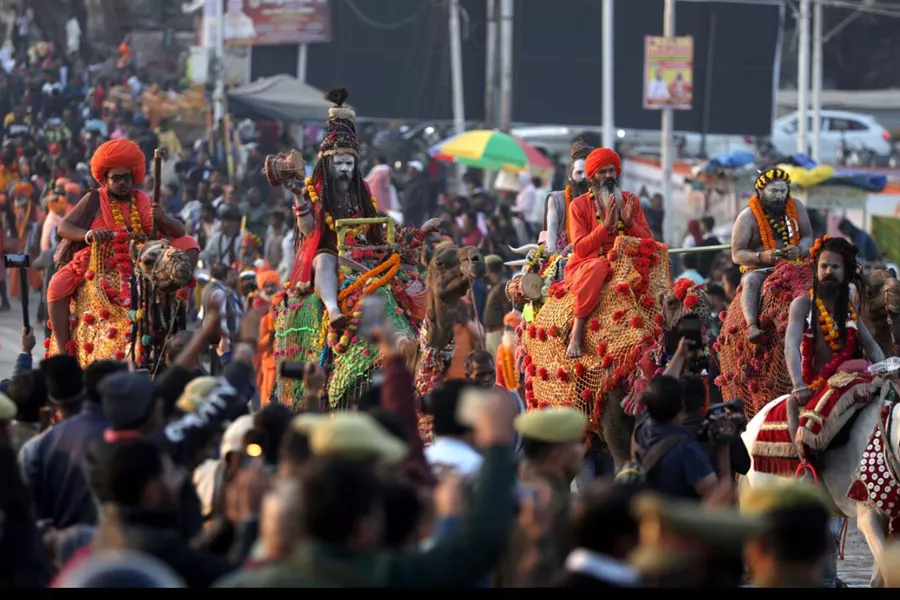
Akharas participate in organized processions and ceremonial bathing associated with major Kumbh gatherings. These events bring different ascetic orders into a shared public setting.
The traditional term Shahi Snan has been widely used for the ceremonial bathing of akharas. Some contemporary events and official communications use other terminology, including Amrit Snan. The wording should be checked against the particular gathering and its current administrative usage.
Naga Sadhus and Public Ceremonies
Naga sadhus are especially visible during some akhara processions. Their distinctive appearance and ascetic practices attract public interest, but they represent only part of the broader akhara system.
Not every member of an akhara is a Naga sadhu, and not every recognized akhara follows the same practices. The public ceremonies bring together multiple religious organizations rather than a single uniform group.
Ceremonial Precedence and Organization
The sequence of participation can depend on established customs and administrative arrangements. It can also vary between Kumbh gatherings and locations.
For example, reporting on the 2025 Maha Kumbh described an organized bathing schedule for the 13 akharas. Such arrangements demonstrate the importance of coordination, but a schedule for one gathering should not be presented as a universal order for all Kumbh events.
Public and Cultural Significance
The akharas make the diversity of India’s ascetic traditions visible to pilgrims, researchers and visitors. Their participation also creates opportunities to learn about religious lineages and ceremonial customs.
However, the Kumbh Mela is larger than the akhara system. Its participants include many other religious communities and pilgrims, so the akharas should be understood as important participants rather than the entirety of the gathering.
What Is the Difference Between an Akhara and a Naga Sadhu?
An akhara is an organization, while a Naga sadhu is a type of ascetic associated with particular religious traditions.
An akhara maintains an institutional identity and may organize initiation, religious practice and participation in ceremonies. A Naga sadhu is an individual whose ascetic identity is shaped by the relevant tradition.
Some akharas are closely associated with Naga sadhus, especially within the Shaiva ascetic orders. However, the terms are not interchangeable, and not every member of every akhara is a Naga sadhu.
The distinction is useful when reading reports about the Kumbh Mela. A procession may include Naga sadhus belonging to an akhara, but the organization itself includes a broader institutional identity.
Are All 13 Akharas Shaiva Akharas?
No. The commonly recognized list includes organizations associated with several religious traditions.
- Shaiva or Sanyasi: Seven akharas, including Juna, Niranjani and Mahanirvani.
- Vaishnava or Vairagi: Three akharas, namely Nirvani Ani, Digambar Ani and Nirmohi Ani.
- Udasin: Bada Udasin and Naya Udasin.
- Nirmal tradition: Nirmal Akhara, often grouped with the Udasin organizations in the conventional three-category list but also treated separately in some accounts.
This presentation explains why sources may describe the list as seven Shaiva, three Vaishnava and three Udasin akharas while other sources give the Nirmal tradition a separate heading. The difference concerns classification, not the commonly recognized total of 13 organizations.
Difference Between an Akhara, Math, Ashram and Temple
These terms describe related but distinct forms of religious organization or space. Their functions can overlap, so the definitions below are general rather than absolute.
| Term | General Meaning | Main Purpose | Important Distinction |
|---|---|---|---|
| Akhara | An organized religious order or institution | Maintain a lineage, ascetic community and associated practices | Refers to an organization or tradition, particularly in Kumbh contexts. |
| Math | A monastic institution or religious seat | Support religious teaching, leadership and institutional continuity | Often associated with an established lineage or monastic head. |
| Ashram | A place or community for spiritual practice | Provide a setting for teaching, residence, study or discipline | Can serve different kinds of spiritual communities and visitors. |
| Temple | A place of worship | Support worship, offerings, rituals and religious gatherings | Primarily describes a place dedicated to worship. |
An akhara may maintain physical centres, while a math or ashram may support teaching and community life. A temple may form part of a larger religious institution. These overlaps do not make the terms synonymous.
Historical sources also show that maths and akharas could serve different roles within ascetic communities. Their exact relationship depends on the tradition and institution concerned.
How Are Akharas Organized and Led?
Akharas do not all follow one identical administrative structure. Their organization depends on their lineage, established customs and institutional history.
In some akharas, senior religious figures hold leadership roles that combine spiritual guidance with organizational responsibilities. Titles such as Mahamandaleshwar appear in accounts of akhara leadership, while other roles and arrangements can differ between institutions.
Several aspects may shape an akhara’s organization:
- Religious leadership: Senior practitioners guide the institution according to its traditions.
- Initiation and membership: Entry into an ascetic lineage follows the relevant organization’s practices.
- Senior ascetics: Experienced members may hold responsibilities within the community.
- Institutional administration: Leaders and designated bodies may manage organizational matters.
- Collective representation: The Akhil Bharatiya Akhara Parishad provides a wider forum for the recognized akharas.
These are broad features, not a universal organizational chart. Current officeholders, specific eligibility requirements and internal decision-making procedures should be verified through the relevant institution before publication.
Common Misconceptions About Akharas
1. Every Akhara Is a Wrestling Institution
The word akhara can refer to a wrestling ground in other settings, but the 13 organizations discussed here are religious institutions associated with ascetic traditions and the Kumbh Mela.
2. Every Akhara Member Is a Naga Sadhu
Naga sadhus are associated with particular ascetic traditions. An akhara is an organization, and its members should not all be assigned the same ascetic identity.
3. All 13 Akharas Follow the Same Religious Tradition
The list includes Shaiva, Vaishnava, Udasin and Nirmal-associated traditions. These categories have different histories and religious emphases.
4. Adi Shankaracharya Personally Founded All 13 Akharas
Traditional accounts connect Adi Shankaracharya with Dashanami monasticism and the organization of ascetic traditions. The individual histories of the 13 institutions require separate evidence, and a single founding claim should not be applied to all of them without qualification.
5. Akharas Have Only Military or Martial Functions
Some ascetic groups had military roles in particular historical periods. This does not mean that all akharas were military organizations or that historical martial activities define their entire religious life.
6. An Akhara and an Ashram Are the Same Thing
An akhara generally refers to an organized religious order or institution, while an ashram describes a place or community for spiritual practice. Their activities may overlap, but the terms have different meanings.
7. All Akharas Follow the Same Procession Order at Every Kumbh
Ceremonial arrangements vary by gathering and location. A published schedule for one event should not be treated as a universal rule.
8. Every Popular Founding Date Is Historically Established
Religious traditions preserve accounts of origins, but not every date has independent documentary support. Historical claims should be checked against scholarly research and institutional records rather than repeated simply because they appear on multiple websites.
Akharas in Modern India
Akharas continue to play a role in India’s religious and cultural life through their institutional traditions and participation in major religious gatherings.
Their contemporary relevance includes:
- Maintaining religious lineages and ascetic identities.
- Participating in public religious ceremonies and Kumbh processions.
- Preserving teachings and practices within established communities.
- Representing distinct traditions within the wider network of religious institutions.
- Contributing to the cultural and historical significance of major pilgrimage gatherings.
The Akhil Bharatiya Akhara Parishad provides a collective institutional framework for the recognized akharas. Its public-facing role and the participation of the organizations in Kumbh arrangements demonstrate that the akhara system remains relevant in contemporary religious life.
At the same time, modern akharas should not be treated as identical institutions. Their practices, leadership, histories and religious emphases vary. Understanding those differences offers a clearer picture of India’s ascetic traditions than treating the 13 names as a single undifferentiated group.
Conclusion
The 13 akharas in India represent a group of established religious organizations associated with ascetic traditions and the Kumbh Mela. Their histories connect with different lineages, forms of religious discipline and institutional developments.
The Shaiva, Vaishnava, Udasin and Nirmal-associated traditions provide a useful starting point for understanding their differences. Their histories also show why traditional accounts, scholarly interpretations and documented institutional records should be distinguished carefully.
Learning about the akharas helps readers understand the organizations behind major religious processions and the wider history of ascetic life in India. For deeper research, institutional publications and scholarly studies offer the best way to explore individual akharas beyond the broad 13-organization list.
Frequently Asked Questions About the 13 Akharas in India
What Are the 13 Akharas in India?
The 13 commonly recognized akharas are Juna, Niranjani, Atal, Mahanirvani, Anand, Avahan, Agni, Nirvani Ani, Digambar Ani, Nirmohi Ani, Bada Udasin, Naya Udasin and Nirmal Akhara. They represent different religious lineages and are associated with the Kumbh Mela.
What Is an Akhara in Hinduism?
An akhara is an organized religious institution associated with a particular ascetic tradition or lineage. It may support religious instruction, initiation, spiritual discipline and participation in religious gatherings. The word also has other meanings, including a wrestling ground, depending on its context.
Why Are There 13 Major Akharas?
Thirteen is the commonly recognized number of major akharas associated with the established Kumbh Mela system. It refers to this specific group of organizations, not every religious order or institution in India that uses the word akhara.
What Are the Main Types of Akharas?
The commonly used categories are Shaiva or Sanyasi, Vaishnava or Vairagi, and Udasin. Some explanations discuss the Nirmal Akhara separately because of its distinctive historical relationship with Sikh religious traditions.
Which Akharas Are Associated with Shaiva Traditions?
The seven commonly listed Shaiva akharas are Juna, Niranjani, Atal, Mahanirvani, Anand, Avahan and Agni. They are associated broadly with Shaiva ascetic traditions, including Dashanami sannyasis.
Which Akharas Are Associated with Vaishnava Traditions?
The three commonly recognized Vaishnava Ani akharas are Nirvani Ani, Digambar Ani and Nirmohi Ani. They are associated with Vaishnava and Vairagi ascetic traditions.
What Are Udasin Akharas?
The two commonly listed Udasin akharas are Bada Udasin and Naya Udasin. Udasin traditions have a complex historical relationship with Sikh religious culture, and their institutions should be understood through their individual histories.
What Is the Nirmal Akhara?
Nirmal Akhara, also called Nirmal Panchayati Akhara, is an organization connected with the Nirmal tradition. Its history includes significant links with Sikh religious culture and scholarship. Some conventional classifications group it with the Udasin organizations, while others discuss it separately.
Are All Akharas Associated with Naga Sadhus?
No. Naga sadhus are ascetics associated with particular traditions, while an akhara is an organization. Some Shaiva akharas are especially associated with Naga sadhus, but the terms do not mean the same thing.
What Is the Relationship Between Akharas and the Kumbh Mela?
Akharas participate in religious processions, ceremonial bathing and other activities associated with the Kumbh Mela. They represent established ascetic lineages and contribute to the gathering’s religious and cultural significance.
Did Adi Shankaracharya Establish All 13 Akharas?
Traditional accounts connect Adi Shankaracharya with Dashanami monasticism and the organization of ascetic traditions. However, the individual histories of the 13 akharas are complex. It is not historically justified to claim without qualification that he personally founded all 13 in their present form.
What Is the Difference Between an Akhara and a Math?
An akhara generally refers to an organized religious order or ascetic institution. A math is a monastic institution or religious seat that supports teaching, leadership and continuity within a lineage. Their functions can overlap, but the terms are not interchangeable.
What Is the Significance of Akharas in Hinduism?
Akharas help maintain religious lineages, ascetic practices, institutional traditions and participation in major religious gatherings. Their importance varies by organization, and their collective presence reflects the diversity of India’s religious history.
Do All Akharas Have the Same Practices?
No. Their practices depend on their religious traditions, institutional histories and internal customs. Shared participation in the Kumbh Mela does not mean that every akhara follows the same teachings, initiation rules or ceremonies.
How Can Readers Verify the Official Names of Akharas?
Readers can consult the Akhil Bharatiya Akhara Parishad, relevant Kumbh Mela administrative authorities, official institutional publications and reputable historical research. Compare full names with common English spellings, as transliteration and shortened forms vary between sources.